The team of Professor Zhang Wei and the team of Professor Li Weiqiang and Xiang Peng from Sun Yat-sen University published new findings in the study of human pluripotent stem cells in the treatment of neurological function in "NATURE COMMUNICATIONS"
The team of Professor Zhang Wei from our school conducted joint research with the team of Professor Li Weiqiang and Professor Xiang Peng from the Stem Cell and Tissue Engineering Research Center of Sun Yat-sen University, and found that pericyte-like cells (hPSC -CNC PCs ) derived from human pluripotent stem cells were transplanted into a stroke mouse model Among them, it can repair the damaged blood-brain barrier and reduce the death of neurons. The research results were published in the journal " NATURE COMMUNICATIONS " published on October 15 , 2020 ( IF : 12.121 )
During the study, researchers finally differentiated human pluripotent stem cells ( hPSCs ) into pericyte ( PC )-like cells ( hPSC-CNC PCs ) via neural crest ( CNC ) , and found that hPSC-CNC PCs Not only express typical pericyte markers, but also have obvious contractile properties, angiogenesis ability and endothelial barrier function. Transplantation of hPSC-CNC PCs into BBB- disrupted stroke ( tMCAO ) mouse model can promote neurological recovery in tMCAO mice by rebuilding BBB integrity and preventing neuronal apoptosis .
This study shows that hPSC-CNC PCs may be an ideal cell source for the treatment of diseases related to BBB dysfunction, which is helpful for the study of the pathogenesis of related diseases and has clinical translational significance.
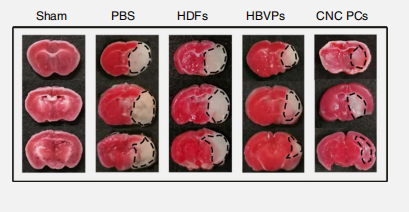
Representative TTC-stainde coronal sections in different groups