
Lu Xuemei's team from the School of Life Sciences and Biopharmaceuticals at our university has made new progress in targeted drug delivery therapy for colorectal cancer
Recently, a research achievement with the first affiliation from the School of Life Sciences and Biopharmaceutics, Guangdong Pharmaceutical University, and the Key Laboratory of Bioactive Drugs Research of Guangdong Province has been formally accepted and published online in the top-tier journal "Acta Biomaterialia" (IF: 10.633) with the corresponding author being Associate Researcher Lu Xuemei. The title of the study is "Mitochondria-targeting folic acid-modified nanoplatform based on mesoporous carbon and a bioactive peptide for improved colorectal cancer treatment." This research reports an oral colon-targeted, mitochondria-targeting drug delivery system (M27-39@FA-MCNs) and represents an extension of the previous work by the research group (published in 2021 in the top-tier journal "Theranostics," IF: 11.6).
Oral colon-specific drug delivery systems (OCDDs) aim to deliver therapeutic drugs specifically to the colon, thereby enhancing drug efficacy, increasing bioavailability, and reducing systemic side effects. This targeted approach is beneficial for the precise treatment of conditions such as colorectal cancer (CRC) and inflammatory bowel disease (IBD). However, the complex physiological changes in the gastrointestinal tract pose significant challenges to the targeted delivery of OCDDs to the affected area, thus affecting treatment outcomes. Additionally, biocompatibility is a prerequisite consideration in the design of targeted drug delivery systems.
The antimicrobial peptide M27-39, derived from Musca domestica cecropin (MDC), is a small-molecule bioactive peptide screened and obtained by the research group. It not only exhibits stronger anti-colorectal cancer activity than MDC but also possesses advantages such as simplified structure, cellular penetration, and lower production cost. Mesoporous carbon nanoparticles exhibit characteristics such as large pore volume, high surface area, high drug loading capacity, good stability, excellent biocompatibility, and remarkable colon adhesion. Furthermore, the high expression of folate (FA) receptors in tumor tissues presents a significant potential for FA-modified mesoporous carbon nanoparticles in targeted drug delivery systems.
In this study, the researchers successfully developed an oral colon-specific, mitochondria-targeting drug delivery system (M27-39@FA-MCNs). Experimental results demonstrated that M27-39@FA-MCNs could target colorectal cancer sites, enhance the accumulation and prolong the retention time of M27-39, significantly improve CRC symptoms in mice, reduce the number and diameter of colorectal tumors in the model mice, alleviate inflammation reactions, and preserve the structural integrity of the colon. The anti-CRC molecular mechanism of M27-39@FA-MCNs may be related to their ability to target mitochondria, disrupt mitochondrial energy metabolism, regulate mitochondrial apoptotic signaling pathways and immune-inflammatory responses, and induce tumor cell apoptosis, thereby enhancing the effectiveness of colorectal cancer treatment. Moreover, this system exhibited good biocompatibility in both cell toxicity evaluation experiments and mouse toxicity evaluation experiments.
Note: This translation provides a summary of the mentioned research on the oral colon-specific drug delivery system (M27-39@FA-MCNs) and its potential benefits for the treatment of colorectal cancer.
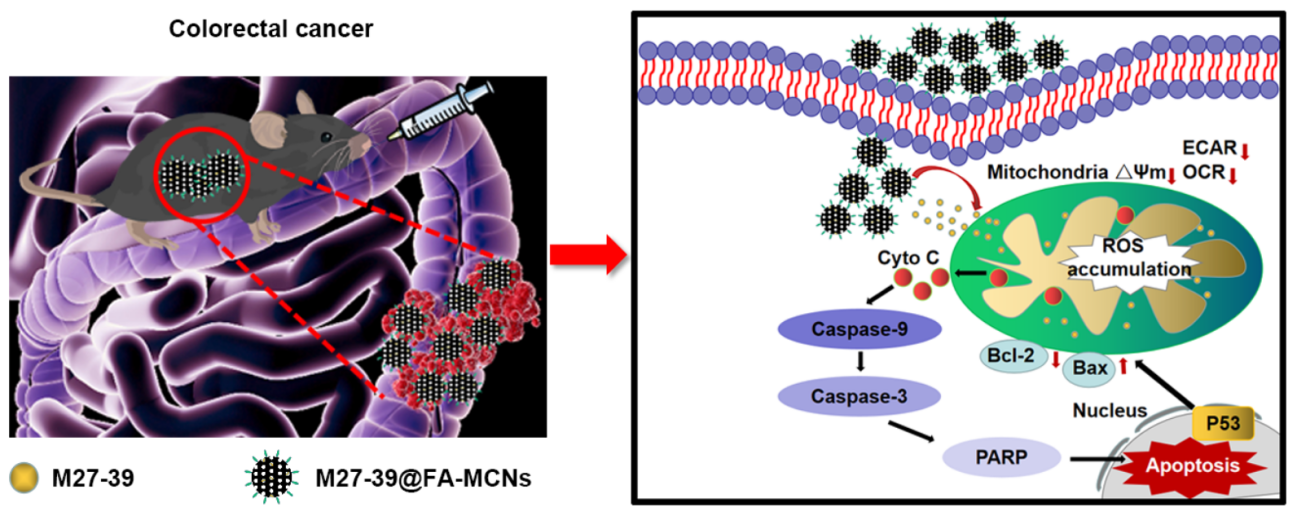
M27-39@FA-MCNs Mechanism diagram of a novel oral nanodrug delivery system targeting colorectal cancer
Website:https://doi.org/10.1016/j.actbio.2022.08.071
Reference:
[1] Mitochondria-targeting folic acid-modified nanoplatform based on mesoporous carbon and a bioactive peptide for improved colorectal cancer treatment, Acta Biomaterialia, 2022. doi.org/10.1016/j.actbio.2022.08.071.