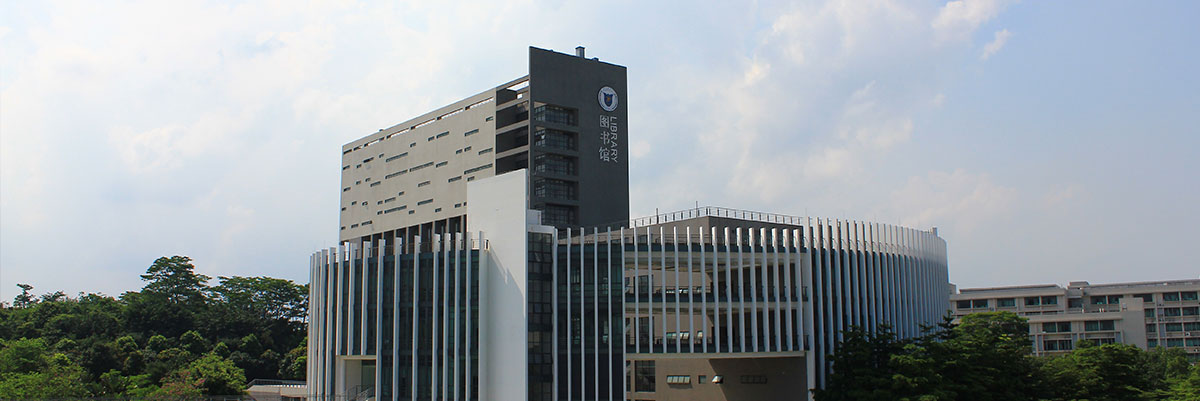
Fu Xi's research group from the School of Public Health of our university revealed the association between indoor environmental microorganisms/plant metabolites, chemicals and asthma risk of junior high school students
Recently, a collaborative team consisting of researchers from our School of Public Health and South China Agricultural University has published a paper titled "Indoor microbiome, microbial and plant metabolites, chemical compounds and asthma symptoms in junior high school students: a multicentre association study in Malaysia" in the prestigious international academic journal European Respiratory Journal (Impact Factor: 33.8). Dr. Fu Xi is the corresponding author of this paper.
In this study, a total of 1,290 junior high school students from three regions in Malaysia, namely Johor Bahru, Terengganu, and Penang, were assessed for asthma symptoms. Simultaneously, classroom dust samples were collected for high-throughput microbial and untargeted metabolomic analysis. The investigation revealed significant variations in the prevalence of asthma among different schools. A total of 2,633 compounds were detected from the classroom environmental samples.
Plant secondary metabolites, including flavonoids/isoflavonoids (glycyrrhizic acid, mangiferin, genistin), indoles and derivatives (indole, 5-hydroxytryptamine, indole-3-aldehyde), and other metabolites (biotin, withaferin A), were found to be significantly enriched in environments with low asthma risk. Neural network analysis demonstrated a high co-occurrence probability between indole derivatives and potentially protective microbial taxa, such as Actinomycetospora, Fischerella, and Truepera, indicating that these taxa might be responsible for the production of indole metabolites. Additionally, certain chemicals, such as insecticides (2(3H)-benzothiazolone), fragrances (2-aminobenzoic acid, isovaleric acid), detergents/microplastics (phthalic acid), and industrial materials (4,4'-sulfonyldiphenol), were found to be enriched in schools with a higher risk of asthma.
This study represents the first attempt to use high-throughput untargeted methods to analyze indoor chemical substances and assess their impact on health. It is also the first study to evaluate the interactions between indoor microbial communities and metabolites. The research revealed that indole and its derivatives, produced by indoor microorganisms, may play a role in mitigating the occurrence and development of asthma symptoms. These findings provide new insights into the control and prevention of asthma, suggesting novel strategies for managing the condition.
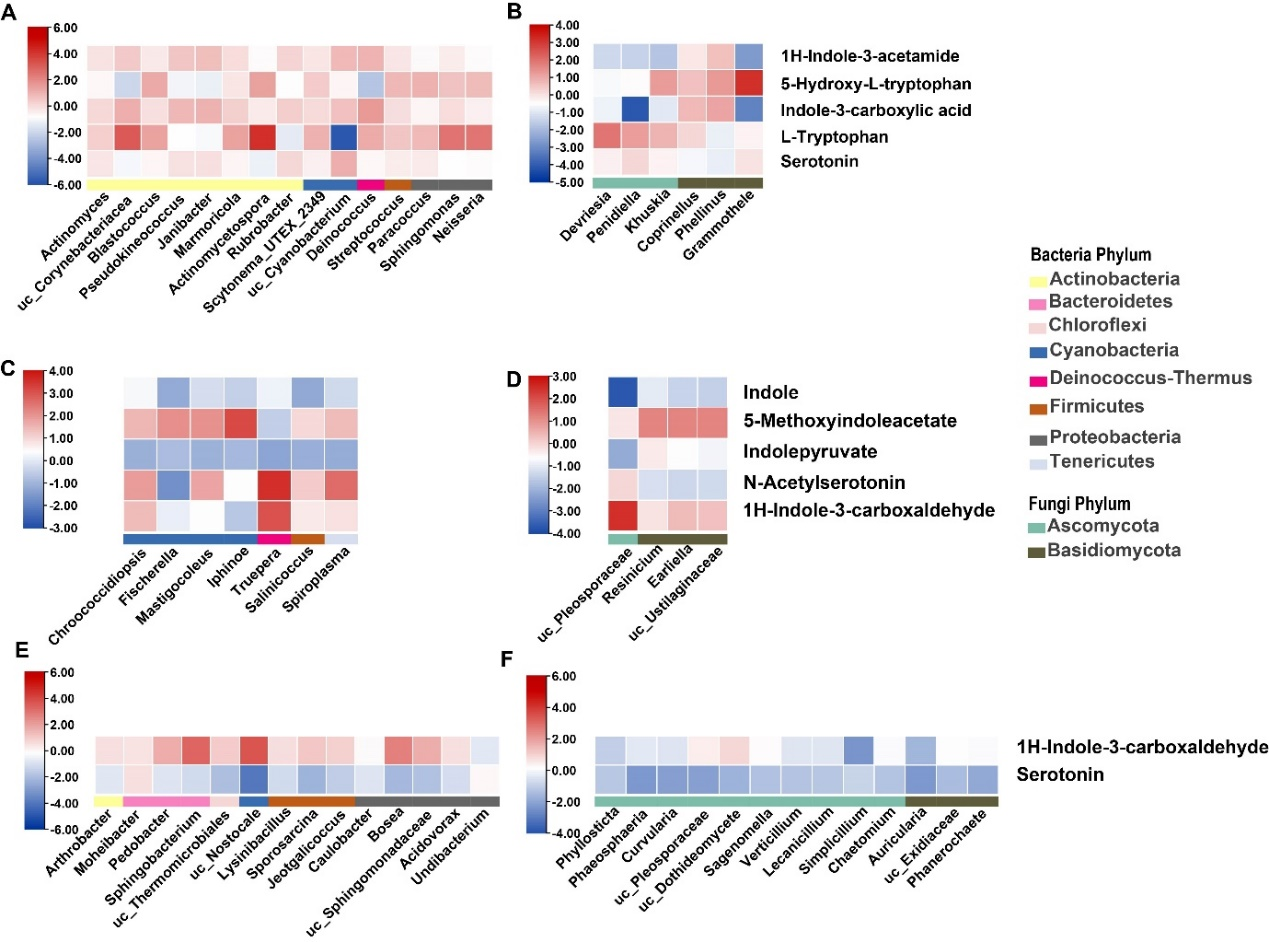
Figure 1: The co occurrence probability of potential protected microbial communities and indole and its derivatives in three regions of Malaysia. A/B: The co-occurrence probability of potential protective bacterial (A) and fungal (B) groups and metabolites in Johor Bahru. C/D: Coexistence probability of potential protective bacterial (C) and fungal (D) groups and metabolites in Terengganu. E/F: The co-occurrence probability of potential protective bacterial (E) and fungal (F) groups and metabolites in Penang.
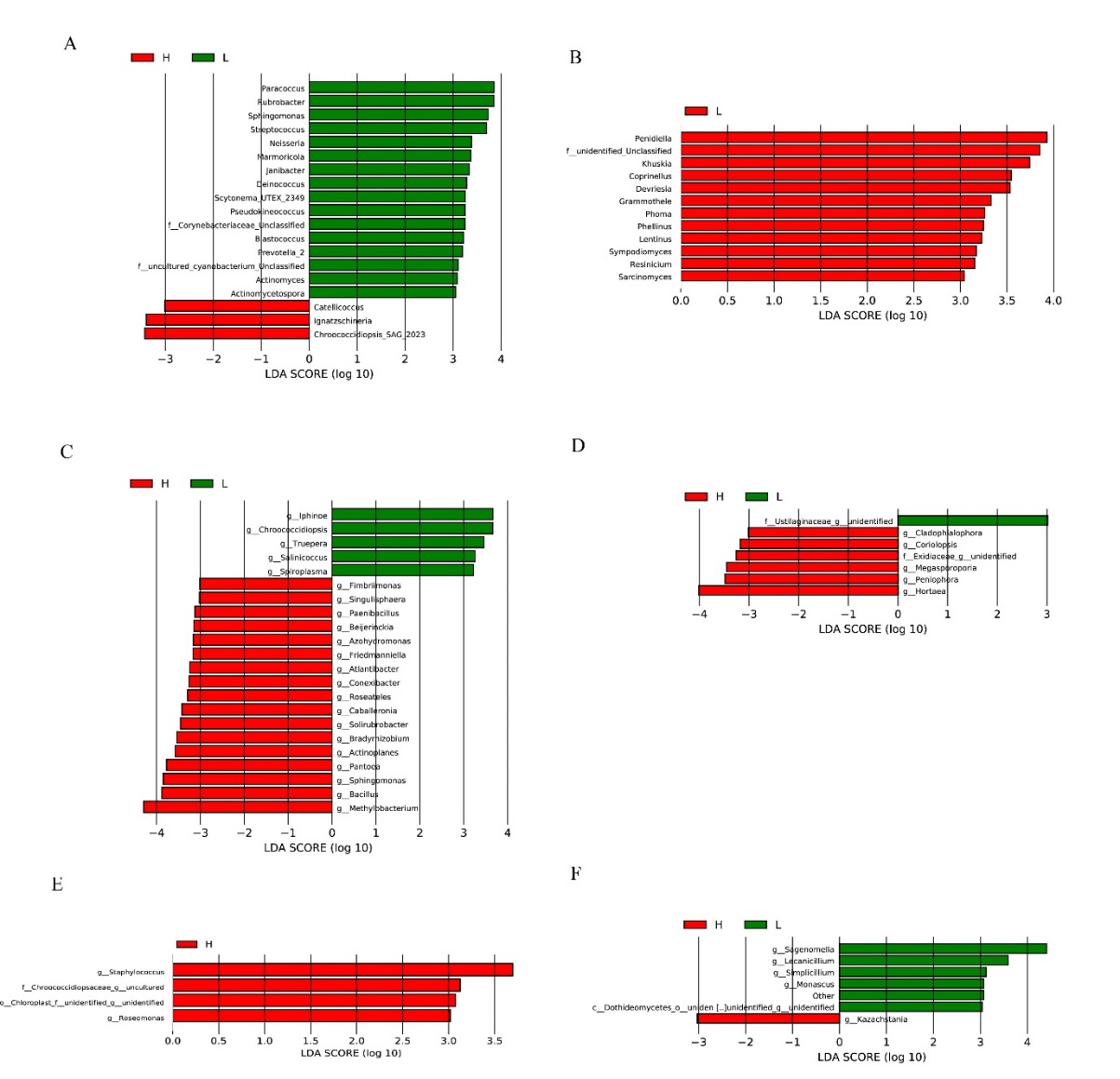
Figure 2 shows the characteristic microbiota rich in schools with low asthma prevalence (L) and high asthma prevalence (H). A/B: Johor Bahru characteristic bacterial (A) and fungal (B) groups. Terengganu's characteristic bacterial (C) and fungal (D) groups. Penang characteristic bacterial (E) and fungal (F) groups.